Most families who contact a rehab center don’t start with clinical terms. They say things like “He drinks too much,” “She can’t stop using,” or “My son is on drugs.” Words like abuse, addiction, dependence, and use disorder get mixed together, and the confusion can delay the help someone needs.
These terms are not the same. Knowing the difference can change how you see your own situation or a loved one’s. It can also change when you ask for help and what kind of care you look for.
This article explains substance use, substance abuse, and substance use disorder (SUD) in plain language, how they differ, and what recovery can look like at each stage.
Why the Words We Use Matter
For decades, “substance abuse” was the everyday phrase for any harmful pattern of drug or alcohol use. It was also an official diagnostic term. But “abuse” carries moral judgment. It suggests a person is choosing to misbehave, when addiction is a health condition involving the brain, behavior, and environment.
Research has shown that stigmatizing language makes people less likely to seek treatment. Someone who feels judged is more likely to hide their struggle, minimize it, or wait until a crisis forces the issue.
Many clinicians now prefer person-first language, such as “a person with a substance use disorder” rather than “an addict” or “an abuser.” This is more than politeness. It reflects the medical understanding that addiction is a treatable condition, not a character flaw.
What Is Substance Use?
Substance use is the broadest and least alarming term. It means consuming alcohol, tobacco, prescription medication, or other drugs. It covers everything from a cup of tea with caffeine to a medication taken exactly as prescribed to an occasional drink at a social event.
Not all substance use is a problem. Many people use substances without losing control, harming their health, or damaging their relationships. Still, “low-risk” doesn’t mean “no-risk.” Any use of an illegal drug carries legal and health risks, and some substances can lead to dependence faster than others.
A helpful way to picture it is a spectrum:
- Non-use: no use of substances at all.
- Experimental or occasional use: trying a substance out of curiosity or using rarely, with no major consequences.
- Regular use: use becomes a habit or routine, even if problems haven’t appeared yet.
- Harmful use (substance abuse): use begins to cause real damage.
- Substance use disorder: use continues despite serious harm and the person can no longer control it.
People can move in either direction along this spectrum. Someone in the middle isn’t doomed, and someone at the far end isn’t beyond help.
What Is Substance Abuse?
“Substance abuse” traditionally describes a pattern of use that causes problems in a person’s life but hasn’t yet reached full dependence. In older diagnostic manuals, it meant repeated use leading to difficulties such as:
- Failing to meet responsibilities at work, school, or home
- Using in physically dangerous situations, such as driving under the influence
- Facing legal trouble related to substance use
- Continuing to use despite arguments, damaged relationships, or social consequences
Consider a university student who binge drinks every weekend. He misses Monday classes, argues with his roommate, and once drives home after drinking. He may not feel a daily craving or experience withdrawal, but his use is clearly harmful. That’s what “abuse” was originally meant to capture: harm without necessarily full dependence.
It’s worth saying clearly that substance abuse is not “harmless” or “just a phase.” The problems caused by this pattern are real, and without change, many people progress to a more serious stage.
Today, “substance abuse” remains common in everyday speech, news, and public health conversation. But in clinical settings, it has largely been replaced by the more precise concept of a substance use disorder.
What Is a Substance Use Disorder?
A substance use disorder is a medical condition diagnosed by a qualified professional. In 2013, the American Psychiatric Association’s DSM-5 merged the older categories of “substance abuse” and “substance dependence” into a single diagnosis, substance use disorder, rated by severity.
A clinician looks at 11 criteria, which fall into four broad groups:
1. Impaired control
- Using more, or for longer, than intended
- Wanting to cut down but being unable to
- Spending a great deal of time obtaining, using, or recovering from the substance
- Strong cravings or urges to use
2. Social impairment
- Failing to fulfill major obligations at work, school, or home
- Continuing to use despite relationship problems caused or worsened by the substance
- Giving up important activities, hobbies, or social events because of use
3. Risky use
- Using in physically hazardous situations
- Continuing to use despite knowing it is causing or worsening a physical or psychological problem
4. Pharmacological criteria
- Tolerance: needing more of the substance to get the same effect
- Withdrawal: experiencing physical or psychological symptoms when use stops or decreases
Severity is determined by how many criteria a person meets:
- Mild: 2 to 3 criteria
- Moderate: 4 to 5 criteria
- Severe: 6 or more criteria
This approach recognizes that problematic use exists on a continuum. A person with a mild disorder may need very different support from someone with a severe one, but both deserve care.
An important point: a diagnosis can only be made by a qualified professional. Reading a checklist online can help you reflect, but it is not a substitute for a proper clinical assessment.
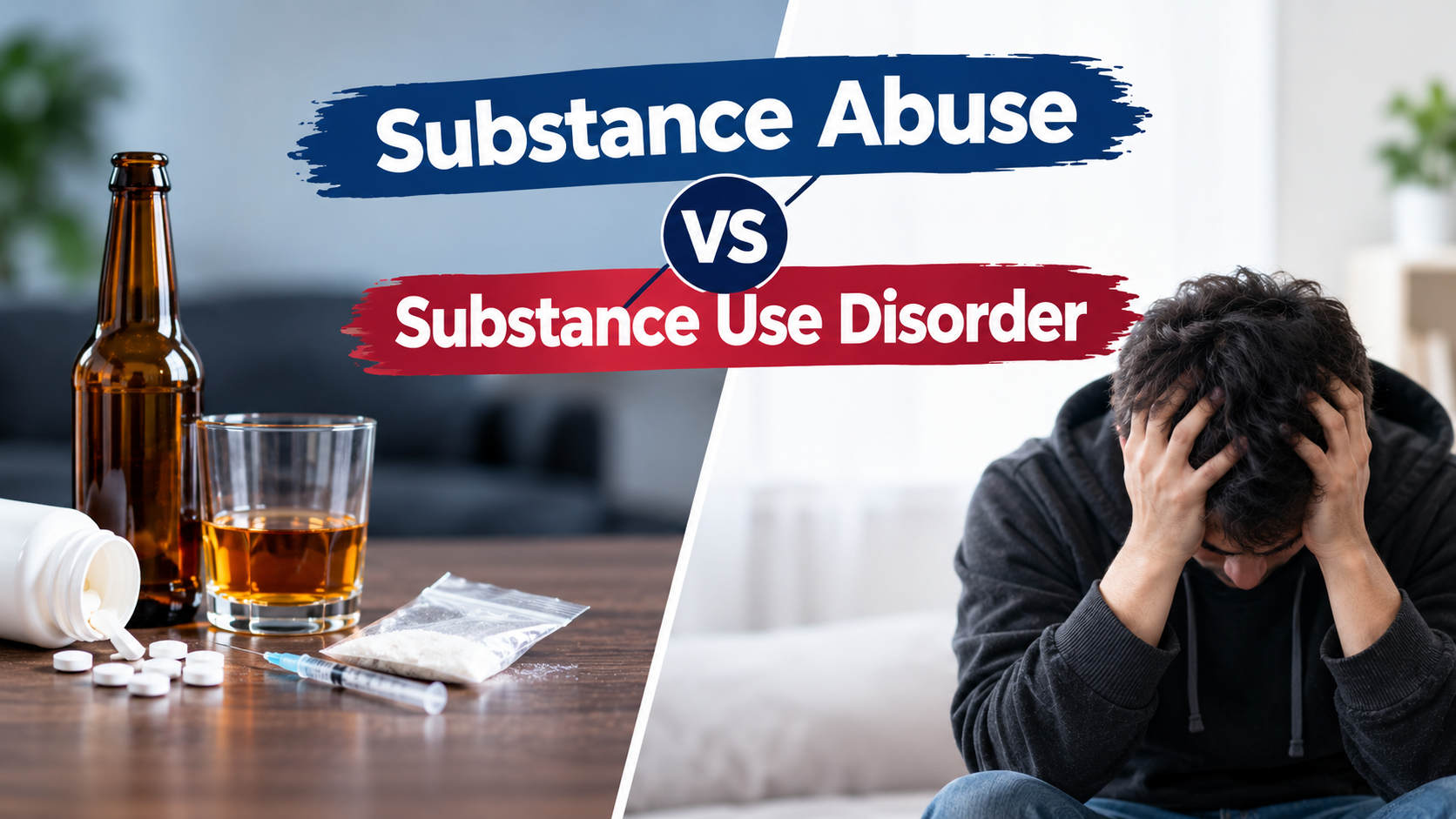
Substance Abuse vs Substance Use Disorder: Key Differences
Here is a simple way to compare the two ideas:
| Substance Abuse (older term) | Substance Use Disorder | |
|---|---|---|
| Status | Informal or outdated diagnostic label | Current clinical diagnosis |
| Focus | Harmful use and its consequences | A pattern of impaired control, harm, and often physiological changes |
| Control | Person may still be able to stop with effort | Person struggles to stop despite wanting to |
| Tolerance/withdrawal | Not required | Often present, especially in moderate to severe cases |
| Severity | One category | Mild, moderate, or severe |
| Language | Can sound judgmental | Medical and non-stigmatizing |
In practice, what people call “substance abuse” often falls within the mild end of a substance use disorder. And what people call “addiction” usually describes the severe end.
The practical takeaway is that you don’t have to be at rock bottom to deserve help. Early intervention is usually easier, less costly, and more effective than waiting for a crisis.
What Causes a Substance Use Disorder?
There is no single cause, and no one chooses to become addicted. Several factors usually combine:
- Genetics and biology: Family history can raise vulnerability. Substances act on the brain’s reward and motivation systems, and repeated use can change how those systems work.
- Mental health conditions: Depression, anxiety, trauma, ADHD, bipolar disorder, and psychosis often go hand in hand with substance use. Some people use substances to self-medicate emotional pain.
- Environment and peers: Easy access, peer pressure, family conflict, or living in a stressful environment increase risk.
- Early exposure: Starting use during adolescence, when the brain is still developing, is linked to a higher chance of later problems.
- Stress, loss, and life pressure: Unemployment, grief, abuse, or sudden life changes can push someone toward substances as a coping tool.
Understanding these causes helps remove blame. Addiction is not a lack of willpower. It involves real changes in brain function, and stopping often requires professional support.
The Link Between Addiction and Mental Health
Substance use disorders and mental health conditions frequently occur together. This is called co-occurring disorders or dual diagnosis. A person might drink heavily to quiet anxiety, or use stimulants such as ICE (crystal methamphetamine) and later develop paranoia or psychotic symptoms. In other cases, long-term drug use triggers or worsens depression.
When both conditions exist, treating only one often leads to relapse. Effective care assesses and treats both together, with psychiatric evaluation, therapy, and medical oversight working as a team. If you’re worried about this overlap, you can read about psychiatric services and mental health care at Healing Door. You can also learn more about related conditions such as bipolar disorder, psychosis treatment, and schizophrenia management.
Warning Signs to Watch For
You don’t need to be a doctor to notice something is wrong. Common warning signs include:
Behavioral signs
- Secrecy, lying, or hiding use
- Sudden changes in friends or routines
- Declining performance at work or school
- Financial problems or unexplained missing money
- Losing interest in hobbies and family time
Physical signs
- Changes in sleep, appetite, or weight
- Unexplained tremors, red eyes, or poor hygiene
- Frequent illness or visible neglect of health
Psychological signs
- Mood swings, irritability, or aggression
- Anxiety, paranoia, or depression
- Defensiveness when use is mentioned
Signs of dependence
- Needing the substance just to feel “normal”
- Withdrawal symptoms such as shaking, sweating, nausea, or insomnia when not using
- Repeated failed attempts to cut down
One sign alone doesn’t confirm a disorder. But a combination, especially lasting more than a few weeks, is worth taking seriously.
How Treatment Works
Recovery is possible at every level of severity. The right approach depends on the individual’s assessment. Here is what quality care generally includes.
1. Comprehensive assessment
Treatment starts with understanding the whole picture: the substance used, the pattern and duration, physical health, mental health, family situation, and personal goals. This step determines whether someone needs residential care, outpatient care, or a combination.
2. Medically supervised detoxification
For many people, withdrawal is the first major hurdle. Depending on the substance, withdrawal can be uncomfortable or dangerous, particularly with alcohol and certain medications. Supervised detoxification provides medical monitoring so the body can adjust safely. Detox alone, however, is not a cure. It is only the first stage.
3. Therapy and counseling
Individual therapy, group counseling, and family sessions help people understand their triggers, change unhealthy thought patterns, and build healthier coping skills. Evidence-based approaches such as cognitive behavioral therapy (CBT) and motivational interviewing are widely used in addiction care.
4. Treatment matched to the substance
Different substances affect the body and mind differently, so treatment should reflect that. Healing Door offers specialized programs including drug addiction treatment, alcohol abuse treatment, ICE rehabilitation, and cocaine addiction treatment. For drug-induced conditions, a psychiatric component may also be needed.
5. Gender-sensitive care
Women often face particular barriers to seeking treatment, including stigma, family expectations, and privacy concerns. A dedicated, confidential setting can make it easier to begin. Healing Door offers a female rehabilitation program for this reason.
6. Relapse prevention and aftercare
Recovery doesn’t end when a program does. Relapse prevention teaches people to recognize triggers, manage cravings, and rebuild daily structure. Aftercare, such as follow-up sessions, family involvement, and ongoing support, helps people stay on track in real life.
You can explore all of these services on the Our Programs page, or read about the clinical team on the About Us page.
Inpatient or Outpatient: Which Is Right?
Not everyone needs the same level of care.
- Outpatient treatment can suit people with milder disorders, stable home environments, and strong support who can attend scheduled sessions while continuing daily life.
- Inpatient (residential) treatment is usually better for moderate to severe disorders, people who have relapsed before, those with serious withdrawal risks, or those with co-occurring psychiatric conditions. Being removed from triggers and surrounded by clinical support can make a major difference.
A professional assessment is the best way to decide. Choosing the wrong level of care isn’t a failure, because treatment can be adjusted as needs change.
How to Support a Loved One
If someone you love is struggling, your reaction matters. A few principles can help:
- Choose a calm moment. Avoid confronting them when they are intoxicated or in the middle of a fight.
- Speak with concern, not accusation. “I’m worried about you” lands differently from “You’re ruining your life.”
- Avoid labels. Describe specific behaviors you’ve seen rather than calling someone an “addict.”
- Don’t enable. Covering up, making excuses, or paying off consequences can unintentionally prolong the problem.
- Look after yourself. Families also feel the strain of addiction. Counseling and support can help you cope.
- Be patient. Many people need several conversations before they are ready to accept help.
Resistance is common and is rarely a sign that someone doesn’t care. Often it comes from fear, shame, or not believing recovery is possible.
Frequently Asked Questions
Is substance abuse the same as addiction?
Not exactly. “Substance abuse” usually refers to harmful use patterns, while addiction typically describes a more severe, compulsive form. Clinically, both fall under substance use disorder, graded from mild to severe.
Can someone have a substance use disorder without being physically dependent?
Yes. Physical dependence (tolerance and withdrawal) is only one of the criteria. A person can meet the diagnosis through loss of control, harm to relationships, and continued use despite consequences.
Can people recover from a substance use disorder?
Yes. Addiction is a treatable condition. Like other chronic health conditions, it can involve setbacks, but many people achieve lasting recovery with the right treatment and ongoing support.
Is a prescription medication safe from becoming a problem?
Not always. Prescription sedatives, opioid painkillers, and stimulants can lead to dependence, especially when taken in higher doses, more often than prescribed, or without medical supervision. If you notice yourself relying on a medication, speak with your doctor rather than stopping abruptly.
How do I know if I need professional help?
If using substances is causing problems in your health, relationships, work, or safety, or you’ve tried to stop and couldn’t, it’s time to talk to a professional. You don’t have to wait for things to get worse.
Final Thoughts
“Substance abuse” and “substance use disorder” are related, but they are not interchangeable. Substance abuse describes harmful patterns of use. A substance use disorder is the formal medical diagnosis, graded by severity, that recognizes how problems with control, behavior, and the body fit together.
The most important thing to remember is that you don’t have to figure out exactly where you or your loved one falls on the spectrum before reaching out. A professional assessment can answer that and point you toward the right level of care.
If you or someone close to you is struggling, support is available. The team at Healing Door Rehab & Psychiatric Center in Bani Gala, Islamabad offers confidential, personalized care, with admissions and support open 24/7. You can contact the team here, call +92 314 992 2547, or browse the FAQs for answers to common questions.
Taking the first step is often the hardest part, and it is usually the one that matters most.